The Deepfake Pandemic: Why Your CEO’s Voice Is No Longer a Security Credential

The Day the Bank Stopped Believing in Voices

It was a Tuesday morning. The manager of a multinational bank in Hong Kong was staring at his screen, listening to a voicemail that had come in overnight. It was the Director of the parent company in the UK.

The voice was unmistakable. It had the specific accent—that clipped, authoritative tone of a C-suite executive who was used to moving billions. The message was urgent: a series of “acquisitions” needed to be approved immediately. Funds needed to move. Now.

Over the next few hours, the manager received follow-up emails. He even received a video call on a secure platform with a senior legal counsel (who appeared on screen but kept his camera off due to “connection issues”). The voice on the phone, the tone of the emails, the urgency—it all fit the corporate culture perfectly.

By the time the fraud was discovered, $35 million had vanished.

It wasn’t an inside job. It wasn’t a hacker brute-forcing a firewall. It was a deepfake.

The criminals had used Generative AI to clone the voice of the Director. They had scraped audio from YouTube interviews, earnings calls, and corporate announcements. They didn’t need to hack the Director’s email; they just needed to sound like him. And they did it flawlessly.

Welcome to the new reality. We are no longer in a world where cybersecurity is about stopping malware. We are entering the era where reality itself is the attack surface.

The Evolution of the Threat: From Text to Hyper-Reality

For the last twenty years, cybersecurity has been a game of cat and mouse with code. We built firewalls to stop intrusions; we deployed antivirus to stop payloads; we used phishing filters to catch the Nigerian prince with the bad grammar.

But Generative AI has changed the rules. It has lowered the barrier to entry for sophisticated social engineering to zero.

Let’s look at the timeline of the attack surface:

· 2015–2019: Phishing 1.0. Bad grammar, suspicious links, obvious spoofed emails. The threat was text-based. Training consisted of “Don’t click that link.”
· 2020–2022: Voice phishing (Vishing) and SMS phishing (Smishing) rise. Attackers use stolen data to personalize messages. But the voices were often robotic. You could usually tell it wasn’t real.
· 2023–Present: The Deepfake Era. With models like OpenAI’s Voice Engine, ElevenLabs, and open-source architectures like Tortoise-TTS, a scammer can clone a voice with three seconds of audio.

Three seconds.

You don’t need hours of studio time. If your CEO gave a keynote at a conference that is posted on YouTube (which they did), or if they have a voicemail greeting on a corporate website (which they do), their voice is now a public API for criminals.

We have moved from credential theft to identity collapse.

Why Traditional Cybersecurity Fails Against Pakistan AI

If you are a Chief Information Security Officer (CISO) or an IT administrator reading this, you might be thinking, “We have Multi-Factor Authentication (MFA). We have Zero Trust architecture. We have SIEM monitoring. We’re fine.”

You are not fine. Here is why traditional controls are obsolete in the face of AI-driven social engineering:

  1. MFA is Blind to Biometrics

Multi-Factor Authentication is designed to protect credentials. But if a fraudster calls your Accounts Payable department, using the perfect mimicry of the CFO’s voice, and verbally authorizes a wire transfer—where does MFA fit in?
It doesn’t. The human ear becomes the authentication factor. And the human ear is easily fooled.

  1. Email Security Can’t Stop a Phone Call

Your Secure Email Gateway (SEG) can block malicious links. It can sandbox attachments. But it cannot stop a phone call. AI-powered attacks are increasingly omnichannel. A criminal might start with a deepfake voicemail, follow up with a perfectly crafted email (written by ChatGPT with no spelling errors), and then text you from a spoofed number.

  1. The “Liveness” Test is Dead

We used to tell employees: “If you’re unsure, ask for a video call.”
Attackers are now using deepfake avatars. There are already cases of fraudsters using real-time deepfake filters during Zoom interviews to get hired at tech companies. If a scammer has enough photos and video of your CFO, they can render a real-time face-swap. If the camera is “broken” (a common excuse), they will just use the voice.

The Psychology of the AI Hack

To understand why this is viral and terrifying, we have to look at psychology. Human beings are hardwired to trust what they see and hear.

When we receive a suspicious email, our lizard brain often triggers a warning. The font looks weird. The greeting is off. The grammar is clunky. We pause.

But when we hear the voice of our boss? When we hear the urgency in their specific cadence? The amygdala (the fear center) overrides the prefrontal cortex (the logic center). We stop thinking about security protocols and start thinking about not disappointing our boss.

Cybercriminals know this. They aren’t targeting your firewalls anymore; they are targeting the hierarchy of authority.

In the $35 million bank heist, the scammers didn’t just clone a voice. They understood the corporate structure. They knew that a mid-level manager would never question the Group Director’s request for a rush transfer. They used the company’s own internal power dynamics as the weapon.

This is called Social Engineering 3.0. It combines:

· OSINT (Open Source Intelligence): AI scrapers that map out who reports to whom, who is on vacation, and who is authorized to approve payments.
· Generative AI: Hyper-realistic voice and video synthesis.
· Urgency Manipulation: Creating a scenario where the victim has no time to “verify” through secondary channels.

The Data That Proves the Panic

If you think this is science fiction or limited to high-level espionage, consider the data coming out of the cybersecurity industry in 2024 and 2025.

· VMware’s Global Incident Response Threat Report found that 66% of organizations experienced cyberattacks that leveraged AI-generated voice and video deepfakes in the past year.
· The Identity Theft Resource Center (ITRC) reports that deepfake-related identity fraud attempts have surged by over 3000% in the last three years.
· Gartner predicts that by 2026, 30% of enterprises will consider identity verification and authentication solutions that account for AI-generated deepfakes as a primary failure point—up from less than 5% today.

We are currently in the “silent crisis” phase. Most companies that get hit by deepfake vishing attacks do not report them. Why? Because admitting that an employee authorized a $500,000 transfer because they thought they heard the CFO’s voice is an admission that your entire security culture is fundamentally broken.

The New Attack Vectors You Haven’t Considered

While we focus on CEOs and wire transfers, the threat landscape is expanding into every corner of the enterprise.

  1. The Help Desk is the New Front Door

IT help desks are designed to be helpful. They are the weakest link in the chain.
Scenario: A hacker uses AI to clone the voice of a remote employee. They call the help desk.
“Hi, this is John in Sales. I’m traveling internationally, and my phone was just stolen. I’m locked out of my Okta. I need my MFA reset right now so I can close a deal.”
The help desk, hearing the correct voice, verifying the employee ID number (which was also scraped from a previous breach or social media), resets the credentials. Within minutes, the hacker is inside the VPN, inside the email, and inside the financial systems. The “employee” never existed in the call.

  1. Synthetic Identity Fraud

Beyond voice, AI is enabling the creation of entirely fake humans. Attackers are using Generative Adversarial Networks (GANs) to create fake driver’s licenses and selfies that pass KYC (Know Your Customer) checks.
We are approaching a point where biometric authentication (facial recognition) is no longer a reliable factor. If a bank’s KYC software can’t tell the difference between a real human and a deepfake video of a human holding a fake ID, the entire concept of digital identity collapses.

  1. Insider Threats via AI Manipulation

What happens when an employee is the victim of a deepfake attack that doesn’t involve money, but involves data?
Imagine a deepfake of the CTO calling an engineer and saying: “We have a critical customer outage. I need you to bypass the change management process and push this patch to the production environment right now.”
The “patch” is ransomware. The employee, believing they are saving the company from an outage, willingly executes the code.

How to Defend Against the Unreal: A Security Framework

So, what do we do? How do we secure an organization when we can no longer trust our eyes or ears?

The answer is not a single software solution. It is a cultural and procedural revolution. We need to move from Zero Trust Architecture to Zero Trust Humanity.

Here is the 5-pillar strategy to deepfake-proof your organization.

Pillar 1: Destroy the “Voice as Authority”

You must train your workforce that a voice—no matter how convincing—is not a valid authentication factor.

· The “Code Word” Protocol: Every executive and finance/IT employee should establish a shared secret or a challenge-response protocol. If a call comes from a senior executive requesting a sensitive action (wire transfer, password reset, data access), the employee is trained to ask: “Okay, what’s the code for today?”
· Out-of-Band Verification: Make it policy: Any request involving financials, credentials, or infrastructure changes must be verified through a secondary, independent channel. If you get a voice call, you must confirm via Slack or a text to a known, pre-saved number (not the number that just called you).

Pillar 2: AI-Detection Software is Now a Utility

Just as we deploy antivirus on endpoints, we must now deploy deepfake detection on communication channels.

· Audio Forensics: Tools like Pindrop, Reality Defender, and others analyze audio calls for artifacts that the human ear cannot detect—phase inconsistencies, unnatural breathing patterns, and spectral artifacts left behind by Generative AI.
· Deepfake Defense: These tools can sit on your VoIP (Voice over Internet Protocol) system and flag inbound calls as “synthetic risk” before they reach the executive.
· Email Authentication: Upgrade to BIMI (Brand Indicators for Message Identification) and ensure DMARC, DKIM, and SPF are enforced strictly. While it doesn’t stop voice, it makes the email trail harder to spoof.

Pillar 3: Red Team Your Humans

You run penetration tests on your network. You need to run them on your employees.

· Simulated Deepfake Attacks: Security teams should now be running vishing simulations using AI voice cloning. Clone the voice of the CEO. Have the AI call the finance team. See who falls for it.
· Data Hygiene: If your CEO’s voice is widely available on public podcasts and YouTube, you have a high risk profile. Conduct an OSINT audit. Find out how much audio, video, and biographical data (family names, hobbies, travel schedules) are publicly available. The more data out there, the more convincing the deepfake.

Pillar 4: Redefine MFA (Multi-Factor Authentication)

We need to add a new factor: Behavioral Authentication.

· Phish-Resistant MFA: Move away from SMS and push notifications. Implement hardware tokens (YubiKeys) or passkeys. These are resistant to real-time man-in-the-middle attacks that often accompany deepfake vishing.
· Entitlement Management: This is critical. Why does an accounts payable clerk have the authority to approve a $1 million wire transfer? Even if they are tricked by a deepfake, the system should stop them. Implement granular access controls. No single human should have the unilateral authority to move massive sums of money or deploy critical code without a secondary approver—regardless of what the voice on the phone says.

Pillar 5: The “Paranoia” Culture

Stop calling it “security awareness training.” That sounds boring. Start calling it “operational paranoia.”
Your employees need to feel empowered to be rude.
In corporate culture, it is hard to say “No” to the CFO. You need to change that.

· Empower Rejection: Teach employees: “It is better to delay a legitimate transaction by 10 minutes than to authorize a fraudulent one in 1 minute.”
· The “Pause” Protocol: Any request that involves urgency, secrecy, or authority must trigger an automatic pause. Scammers rely on urgency to bypass critical thinking. If someone is rushing you, they are likely manipulating you.

The Future: The Collapse of Digital Trust

As we look toward the next 5 years, the implications of deepfake technology extend far beyond corporate bank accounts.

We are approaching a phenomenon known as the “Digital Trust Collapse.”

Soon, we will not be able to trust any piece of media we consume. When a video of a politician saying something inflammatory emerges, we won’t know if it’s real. When a CEO announces a merger, we won’t know if it’s a market-manipulation deepfake. When a soldier calls home from a war zone asking for help, families won’t know if it’s a scam.

The cybersecurity industry is racing to solve this with Content Provenance and Authenticity (C2PA) standards—essentially digital watermarks or cryptographic signatures baked into media at the point of capture. Adobe, Microsoft, and others are pushing for a “nutrition label” for content.

But until those standards are ubiquitous, we are in a dangerous limbo period.

A Call to Action for Leaders

If you are a CEO, CTO, or CISO, you need to treat AI-powered social engineering as your number one enterprise risk.

Here is your checklist for Monday morning:

  1. Inventory Your Voice: Go to YouTube and search for your executive team’s names. Assume all that audio is compromised. If they have done podcasts, they are high risk.
  2. Update the Incident Response Plan: Does your IR plan have a section for “Deepfake Vishing”? If not, add it. Outline the steps to take when an employee reports a suspicious AI-generated call.
  3. The $35 Million Question: Gather your finance team. Ask them: “If the CFO called you right now, on your cell phone, at 6:00 PM on a Friday, and told you to move $500,000 to a vendor for an ‘acquisition,’ what would you do?”
    Listen to their answer. If the answer is “I’d do it,” you have a critical vulnerability.
  4. Invest in the Stack: Look at vendors like Material Security for email, Proofpoint for phishing defense, and Pindrop or NISOS for voice and identity threat protection. Cybersecurity budgets must now allocate specifically for “AI Defense.”

Conclusion: The Human Firewall 2.0

For the last decade, cybersecurity professionals have preached about the “human firewall.” We taught people to spot a phishing email. We taught them to create strong passwords.

But we are now asking the human firewall to do something exponentially harder: We are asking them to doubt reality.

We are asking a manager to listen to their boss’s voice—a voice they have heard a thousand times—and say, “I’m sorry, sir, but I need you to prove you are you.”

This is uncomfortable. It flies in the face of traditional corporate hierarchy. But in the age of Generative AI, it is survival.

The criminals aren’t trying to break your encryption. They aren’t trying to find a zero-day vulnerability in your cloud infrastructure. They are simply trying to be you. And thanks to AI, they are getting terrifyingly good at it.

The question isn’t if a deepfake attack will target your organization. It already has. The question is whether your people will recognize that the voice on the line isn’t your CEO—it’s a ghost in the machine.

Secure your voice. Verify everything. Trust nothing.

Share this post with your CFO. Seriously. Do it now.
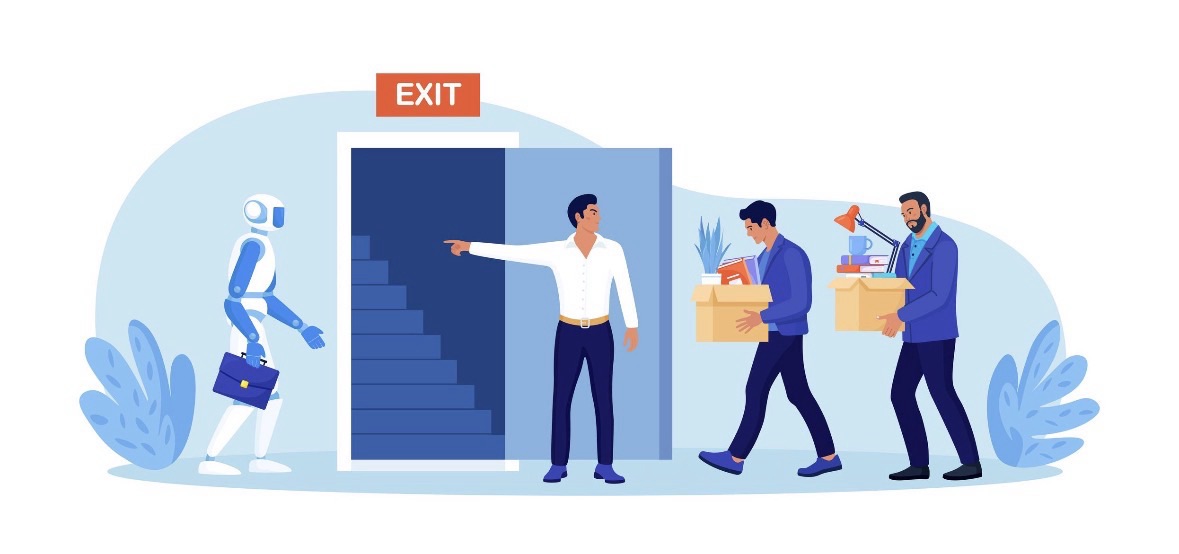
AI Is Replacing Jobs Faster Than Ever (2026 Survival Guide to Stay Relevant and Future-Proof Your Career)

Artificial intelligence is no longer a futuristic concept discussed in tech circles. It is now deeply embedded in everyday business operations, decision-making processes, and workforce strategies. In 2026, AI has moved from being a competitive advantage to a fundamental requirement for companies that want to survive and scale.

This shift is creating a massive transformation in the global job market. Roles that once seemed stable are disappearing or evolving at a pace most people are not prepared for. While previous technological revolutions automated physical labor, this one is targeting cognitive work, including tasks that require analysis, communication, and even creativity.

The uncomfortable truth is that many people are still underestimating how quickly this change is happening. AI is not just impacting large corporations or tech companies. It is affecting small businesses, freelancers, and professionals across nearly every industry.

However, this transformation is not purely negative. It presents one of the greatest opportunities in modern history for those who are willing to adapt, learn, and reposition themselves strategically.

This article breaks down exactly which jobs are most at risk, why they are vulnerable, and most importantly, how you can future-proof your career in an AI-driven world.


Why AI Is Replacing Jobs So Quickly

To understand which jobs are at risk, you first need to understand why AI is so effective at replacing certain types of work.

AI excels in four key areas:

Speed and efficiency
AI systems can process massive amounts of data in seconds, completing tasks that would take humans hours or days.

Consistency and accuracy
Unlike humans, AI does not get tired, distracted, or make frequent errors when performing repetitive tasks.

Scalability
One AI system can replace the workload of dozens or even hundreds of employees simultaneously.

Cost reduction
For companies, replacing human labor with AI often leads to significant long-term savings.

Because of these advantages, businesses are aggressively adopting AI wherever possible. The result is a rapid decline in roles that involve predictable, repeatable work.


Jobs Most Likely to Be Replaced by AI

1. Data Entry and Administrative Roles

Data entry has become one of the most vulnerable job categories. AI systems can extract, organize, and input data far more efficiently than humans.

Administrative roles are also being heavily impacted. Tasks such as scheduling meetings, managing emails, and organizing documents are now handled by AI-powered assistants.

Examples of affected roles include:

  • Data entry clerks
  • Administrative assistants
  • Office coordinators

These positions are particularly at risk because they rely on structured processes that AI can easily replicate.


2. Customer Service and Support

Customer service has undergone a major transformation with the rise of AI chatbots and virtual assistants. These systems can handle thousands of customer interactions simultaneously, providing instant responses at any time of day.

AI is now capable of:

  • Answering common questions
  • Resolving basic issues
  • Routing complex cases to human agents

As a result, many companies are reducing their reliance on human customer service representatives.

Roles being affected include:

  • Call center agents
  • Live chat support staff
  • Technical support representatives (entry-level)

While human agents are still needed for complex or sensitive situations, the overall demand for these roles is declining.


3. Retail and Cashier Jobs

Retail is another industry experiencing rapid automation. Self-checkout systems and AI-powered stores are reducing the need for cashiers and floor staff.

In some locations, fully automated stores allow customers to walk in, pick up items, and leave without interacting with a human employee.

Jobs at risk include:

  • Cashiers
  • Retail associates
  • Inventory clerks

This trend is expected to continue as technology becomes more affordable and widely adopted.


4. Transportation and Delivery

Advancements in autonomous vehicles are beginning to impact transportation-related jobs. While full automation is not yet universal, progress is accelerating.

Roles that may be affected in the near future include:

  • Truck drivers
  • Delivery drivers
  • Taxi and rideshare drivers

Even partial automation, such as driver-assist systems, is reducing the number of human workers required.


5. Basic Finance and Accounting

AI is transforming the finance industry by automating tasks such as bookkeeping, transaction processing, and financial reporting.

Modern AI systems can:

  • Track expenses
  • Generate reports
  • Detect anomalies and fraud

As a result, entry-level accounting roles are becoming less common.

Jobs at risk include:

  • Bookkeepers
  • Accounting clerks
  • Payroll administrators

Higher-level financial professionals who focus on strategy and analysis are less affected.


6. Entry-Level Tech Jobs

Ironically, even the tech industry is not immune to AI disruption. Tools that can generate code, debug programs, and build applications are reducing the need for junior developers.

AI can now:

  • Write basic code
  • Suggest improvements
  • Automate testing

This does not mean developers are obsolete, but it does mean the bar for entry-level positions is rising.


7. Content Creation and Writing

AI-generated content has improved significantly in recent years. It can now produce articles, marketing copy, and even creative writing at scale.

Roles most affected include:

  • Basic content writers
  • Copywriters focused on repetitive tasks
  • Proofreaders and editors

However, high-quality, original content that requires deep thinking and unique perspectives still relies on human creators.


The Pattern Behind Job Displacement

If you look closely, every job at risk shares common characteristics.

These jobs are:

  • Repetitive
  • Rule-based
  • Predictable
  • Easy to standardize

If a task can be broken down into a clear set of instructions, AI can likely learn to perform it.

This is the key principle that determines whether a job is vulnerable.


Jobs That Are Safer in the Age of AI

While many roles are being replaced, others remain relatively secure due to the nature of the work involved.

1. Skilled Trades

Jobs that require physical labor and hands-on expertise are difficult to automate.

Examples include:

  • Electricians
  • Plumbers
  • Construction workers

These roles require adaptability and problem-solving in real-world environments, which AI struggles to replicate.


2. Healthcare Professionals

Healthcare relies heavily on human judgment, empathy, and interpersonal interaction.

Roles such as:

  • Nurses
  • Doctors
  • Therapists

are less likely to be fully replaced, although AI will continue to assist in diagnostics and data analysis.


3. Leadership and Management

Leadership involves decision-making, emotional intelligence, and strategic thinking.

Managers who can:

  • Lead teams
  • Make complex decisions
  • Navigate uncertainty

will remain valuable in an AI-driven world.


4. Creative and Strategic Roles

True creativity and innovation are still areas where humans have an advantage.

Jobs that involve:

  • Original thinking
  • Brand strategy
  • High-level problem-solving

are less likely to be automated.


How to Avoid Being Replaced by AI

Understanding the risks is only the first step. The real question is how to position yourself for long-term success.

1. Learn How to Use AI

The most effective way to stay relevant is to become proficient with AI tools.

Instead of competing with AI, you should:

  • Use it to increase productivity
  • Automate repetitive tasks
  • Enhance your output

People who can leverage AI effectively will outperform those who ignore it.


2. Develop a Skill Stack

Relying on a single skill is becoming increasingly risky. Instead, focus on combining multiple skills to create a unique profile.

For example:

  • Writing + SEO + AI tools
  • Coding + product thinking + communication
  • Marketing + analytics + automation

This approach makes you more adaptable and harder to replace.


3. Focus on High-Value Work

Shift your focus away from tasks that can be automated and toward work that requires human insight.

High-value skills include:

  • Critical thinking
  • Decision-making
  • Problem-solving
  • Communication

These abilities are difficult for AI to replicate and are highly valued by employers.


4. Move Up the Value Chain

Instead of performing basic tasks, aim to take on roles that involve oversight and strategy.

This means:

  • Managing systems rather than operating them
  • Designing processes instead of following them
  • Leading projects instead of executing small tasks

The higher you move, the less replaceable you become.


5. Build a Personal Brand

In a world where AI can replicate skills, reputation becomes a powerful differentiator.

Building a personal brand involves:

  • Sharing knowledge online
  • Creating content
  • Engaging with your industry

When people recognize your name and expertise, you become more than just another replaceable worker.


6. Commit to Continuous Learning

The pace of change is accelerating. Skills that are valuable today may become outdated within a few years.

To stay ahead:

  • Learn new tools regularly
  • Stay informed about industry trends
  • Invest in education and training

Adaptability is one of the most important traits in the modern workforce.


The Biggest Mistakes People Are Making

Many individuals are making critical errors that increase their risk of being replaced.

These include:

  • Ignoring AI altogether
  • Relying on outdated skills
  • Avoiding change
  • Underestimating the speed of disruption

These mistakes can lead to sudden job loss and difficulty finding new opportunities.


The Future of Work

The future of work is not about humans versus AI. It is about humans working alongside AI.

Key trends include:

  • Increased automation of routine tasks
  • Greater demand for high-skill workers
  • Fewer entry-level opportunities
  • More emphasis on adaptability

While some jobs will disappear, new roles will emerge that we cannot fully predict yet.


Final Thoughts: Adaptation Is No Longer Optional

AI is reshaping the job market at an unprecedented rate. The traditional idea of job security is being replaced by a new reality where adaptability is the most valuable asset.

The people who succeed in this new environment will not necessarily be the most experienced or the most educated. They will be the ones who are willing to learn, evolve, and embrace change.

If you take action now, you can position yourself ahead of the curve. If you wait, you risk being left behind.

The choice is simple but critical.

You can resist the changes brought by AI and struggle to keep up, or you can adapt, learn how to use these tools, and build a career that thrives in the new economy.

The future is not something that happens to you. It is something you prepare for.

Start now.

AI in 2026: How Artificial Intelligence Is Transforming Jobs, Security, and the Future

Artificial Intelligence is no longer a concept confined to science fiction or tech labs. It is a living, evolving force embedded in the systems we use every day. From the way businesses operate to how individuals communicate, learn, and make decisions, AI is rapidly becoming the invisible engine driving modern life.

What makes this moment different from previous technological shifts is speed. The pace at which AI is advancing is unprecedented. Entire industries are being reshaped in a matter of years, not decades. Skills are becoming outdated faster than ever, and new opportunities are emerging just as quickly.

The reality is simple: AI is not coming in the future. It is already here, and it is accelerating.

AI Is No Longer a Tool — It’s Becoming the System

In the early days, AI functioned as a support tool. It helped automate repetitive tasks, analyze large datasets, and improve efficiency in specific areas. Businesses adopted it cautiously, using it to enhance existing processes rather than redefine them.

That era is over.

Today, AI is evolving into something much larger. It is no longer just assisting systems; it is becoming the system itself. Modern AI models can write code, generate content, analyze complex data, and even make decisions with minimal human input. These systems are not just reactive—they are proactive.

We are entering the age of autonomous and agent-based AI. These systems can:

Execute multi-step tasks without supervision Learn and adapt in real time Interact with other systems and tools Make decisions based on dynamic inputs

This shift represents a fundamental transformation. Instead of humans directing every action, AI systems are increasingly taking initiative. Businesses are beginning to rely on AI not just for efficiency, but for strategy.

In practical terms, this means:

Customer service is being handled by AI agents Marketing campaigns are being generated and optimized automatically Financial forecasting is being driven by machine learning models Software development is being accelerated through AI-generated code

AI is no longer sitting on the sidelines. It is moving into the center of operations.

The Acceleration Effect: Why AI Is Moving So Fast

One of the most important aspects of AI’s rise is the concept of acceleration. AI improves itself by learning from data, and as more people use AI systems, the amount of data increases exponentially.

This creates a feedback loop:

More users generate more data More data improves AI performance Better performance attracts more users

The result is exponential growth.

Unlike traditional technologies, which often progress in linear steps, AI evolves in leaps. Breakthroughs that once took years are now happening in months. Capabilities that seemed impossible just a short time ago are becoming standard features.

This acceleration is being driven by several key factors:

Advances in computing power The availability of massive datasets Improvements in machine learning algorithms Increased investment from major tech companies

The combination of these factors has created a perfect environment for rapid innovation.

The Double-Edged Sword of AI

While AI offers enormous benefits, it also introduces significant risks. The same capabilities that make AI powerful can also be used in harmful ways.

One of the most pressing concerns is cybersecurity.

AI has transformed how organizations defend against threats. It can detect anomalies, identify vulnerabilities, and respond to attacks faster than any human team. However, attackers are also using AI to enhance their capabilities.

This has led to a new kind of arms race.

AI-powered cyber threats can:

Automatically scan systems for weaknesses Generate highly convincing phishing attacks Adapt to security measures in real time Scale attacks across multiple targets simultaneously

The result is a more complex and dangerous digital landscape.

Beyond cybersecurity, AI also raises concerns about misinformation. AI-generated content can be used to create fake news, deepfakes, and misleading information at scale. As these tools become more sophisticated, it becomes increasingly difficult to distinguish between what is real and what is artificial.

This has serious implications for trust, media, and society as a whole.

The Hidden Cost: Data and Privacy

AI systems rely heavily on data. The more data they have, the better they perform. This creates a tension between innovation and privacy.

Every interaction with AI generates data. This includes:

Search queries Messages and prompts Behavioral patterns Preferences and habits

Over time, this data can be used to build detailed profiles of individuals.

The challenge is that many users are not fully aware of how their data is being collected and used. While regulations are beginning to address these issues, they often struggle to keep pace with technological advancements.

Privacy is becoming one of the defining issues of the AI era.

There are several key concerns:

Lack of transparency in data collection Potential misuse of personal information Data breaches and security risks The ethical implications of surveillance

As AI continues to evolve, the balance between convenience and privacy will become increasingly important.

AI and the Transformation of Work

One of the most visible impacts of AI is its effect on the workforce.

There is a common narrative that AI will eliminate jobs. While there is some truth to this, the reality is more nuanced. AI is not simply removing jobs; it is transforming them.

Many roles that involve repetitive or predictable tasks are being automated. This includes:

Data entry Basic customer support Routine analysis Administrative tasks

At the same time, new roles are being created. These often require a different set of skills, including:

Working alongside AI systems Interpreting AI-generated insights Managing and optimizing AI tools Creative and strategic thinking

The key shift is from execution to oversight.

Workers are increasingly expected to guide, supervise, and collaborate with AI rather than perform tasks manually. This requires adaptability and a willingness to learn new skills.

The concept of “AI literacy” is becoming essential. Understanding how AI works, what it can do, and how to use it effectively will be a critical advantage in the job market.

The Rise of the AI-Augmented Individual

One of the most exciting aspects of AI is its ability to amplify human capabilities.

Individuals can now achieve more than ever before by leveraging AI tools. This includes:

Creating content at scale Building businesses with fewer resources Learning new skills بسرعة Automating personal workflows

A single व्यक्ति can now perform tasks that previously required entire teams.

This has led to the rise of the AI-augmented individual—a person who uses AI to enhance their productivity, creativity, and decision-making.

For example:

A content creator can generate articles, videos, and social media posts with AI assistance An entrepreneur can automate customer interactions and marketing campaigns A developer can write and debug code more efficiently

This shift is lowering barriers to entry across many fields.

However, it also increases competition. As more people gain access to powerful tools, standing out becomes more challenging.

Businesses in the Age of AI

For businesses, AI represents both an opportunity and a necessity.

Organizations that successfully integrate AI can achieve:

Increased efficiency Better decision-making Enhanced customer experiences Reduced operational costs

However, adopting AI is not simply a matter of implementing new technology. It requires a fundamental shift in mindset.

Businesses must rethink how they operate, including:

Redesigning workflows to incorporate AI Training employees to work with AI tools Ensuring ethical and responsible use of AI Managing data effectively

Companies that fail to adapt risk falling behind.

At the same time, there is a growing divide between organizations that leverage AI effectively and those that do not. This gap is likely to widen over time, creating a competitive advantage for early adopters.

Ethical Challenges and Responsibility

As AI becomes more powerful, questions about ethics and responsibility become more important.

Key issues include:

Bias in AI systems Accountability for AI decisions The impact on employment The use of AI in surveillance and control

AI systems are only as good as the data they are trained on. If that data contains biases, the AI can perpetuate or even amplify those biases.

This raises important questions:

Who is responsible when AI makes a mistake? How can we ensure fairness and transparency? What safeguards should be in place?

Addressing these challenges will require collaboration between governments, businesses, and researchers.

The Global AI Race

AI is not just a technological issue; it is also a geopolitical one.

Countries around the world are investing heavily in AI to gain a competitive edge. This includes:

Developing advanced AI technologies Building infrastructure to support AI Training a skilled workforce Establishing regulations and standards

The global race for AI leadership has significant implications for economic power, national security, and international relations.

Nations that lead in AI will have a major advantage in shaping the future.

What Happens Next?

Predicting the future of AI is difficult because of its rapid pace of change. However, several trends are likely to define the next phase:

Increased Autonomy AI systems will become more independent, handling complex tasks with minimal human input. Deeper Integration AI will be embedded in more aspects of daily life, from smart homes to healthcare. Improved Human-AI Collaboration The relationship between humans and AI will become more seamless and intuitive. Stronger Regulation Governments will introduce new rules to address privacy, security, and ethical concerns. Continued Innovation Breakthroughs in AI will continue to push the boundaries of what is possible.

The Bottom Line

Artificial Intelligence is not just another technological trend. It is a transformative force that is reshaping the world at every level.

It is changing how we work, how we communicate, how we make decisions, and how we understand information.

The impact of AI will not be evenly distributed. Some individuals and organizations will benefit greatly, while others may struggle to adapt.

The key to navigating this new landscape is awareness and action.

Learn how AI works Explore how it can be used effectively Stay informed about its risks and implications Adapt to the changing environment

The future will belong to those who understand and embrace AI, not those who ignore it.

SEO Title:

AI in 2026: How Artificial Intelligence Is Transforming Jobs, Security, and the Future

Brief Description:

Artificial Intelligence is evolving at an unprecedented pace, transforming industries, redefining jobs, and raising new challenges in cybersecurity and privacy. This in-depth article explores how AI is reshaping the world in 2026 and what it means for individuals, businesses, and the future.

osion: How Artificial Intelligence Is Rewriting the Future (Faster Than You Think)

Artificial Intelligence is no longer a concept confined to science fiction or tech labs. It is a living, evolving force embedded in the systems we use every day. From the way businesses operate to how individuals communicate, learn, and make decisions, AI is rapidly becoming the invisible engine driving modern life.

What makes this moment different from previous technological shifts is speed. The pace at which AI is advancing is unprecedented. Entire industries are being reshaped in a matter of years, not decades. Skills are becoming outdated faster than ever, and new opportunities are emerging just as quickly.

The reality is simple: AI is not coming in the future. It is already here, and it is accelerating.

AI Is No Longer a Tool — It’s Becoming the System

In the early days, AI functioned as a support tool. It helped automate repetitive tasks, analyze large datasets, and improve efficiency in specific areas. Businesses adopted it cautiously, using it to enhance existing processes rather than redefine them.

That era is over.

Today, AI is evolving into something much larger. It is no longer just assisting systems; it is becoming the system itself. Modern AI models can write code, generate content, analyze complex data, and even make decisions with minimal human input. These systems are not just reactive—they are proactive.

We are entering the age of autonomous and agent-based AI. These systems can:

Execute multi-step tasks without supervision Learn and adapt in real time Interact with other systems and tools Make decisions based on dynamic inputs

This shift represents a fundamental transformation. Instead of humans directing every action, AI systems are increasingly taking initiative. Businesses are beginning to rely on AI not just for efficiency, but for strategy.

In practical terms, this means:

Customer service is being handled by AI agents Marketing campaigns are being generated and optimized automatically Financial forecasting is being driven by machine learning models Software development is being accelerated through AI-generated code

AI is no longer sitting on the sidelines. It is moving into the center of operations.

The Acceleration Effect: Why AI Is Moving So Fast

One of the most important aspects of AI’s rise is the concept of acceleration. AI improves itself by learning from data, and as more people use AI systems, the amount of data increases exponentially.

This creates a feedback loop:

More users generate more data More data improves AI performance Better performance attracts more users

The result is exponential growth.

Unlike traditional technologies, which often progress in linear steps, AI evolves in leaps. Breakthroughs that once took years are now happening in months. Capabilities that seemed impossible just a short time ago are becoming standard features.

This acceleration is being driven by several key factors:

Advances in computing power The availability of massive datasets Improvements in machine learning algorithms Increased investment from major tech companies

The combination of these factors has created a perfect environment for rapid innovation.

The Double-Edged Sword of AI

While AI offers enormous benefits, it also introduces significant risks. The same capabilities that make AI powerful can also be used in harmful ways.

One of the most pressing concerns is cybersecurity.

AI has transformed how organizations defend against threats. It can detect anomalies, identify vulnerabilities, and respond to attacks faster than any human team. However, attackers are also using AI to enhance their capabilities.

This has led to a new kind of arms race.

AI-powered cyber threats can:

Automatically scan systems for weaknesses Generate highly convincing phishing attacks Adapt to security measures in real time Scale attacks across multiple targets simultaneously

The result is a more complex and dangerous digital landscape.

Beyond cybersecurity, AI also raises concerns about misinformation. AI-generated content can be used to create fake news, deepfakes, and misleading information at scale. As these tools become more sophisticated, it becomes increasingly difficult to distinguish between what is real and what is artificial.

This has serious implications for trust, media, and society as a whole.

The Hidden Cost: Data and Privacy

AI systems rely heavily on data. The more data they have, the better they perform. This creates a tension between innovation and privacy.

Every interaction with AI generates data. This includes:

Search queries Messages and prompts Behavioral patterns Preferences and habits

Over time, this data can be used to build detailed profiles of individuals.

The challenge is that many users are not fully aware of how their data is being collected and used. While regulations are beginning to address these issues, they often struggle to keep pace with technological advancements.

Privacy is becoming one of the defining issues of the AI era.

There are several key concerns:

Lack of transparency in data collection Potential misuse of personal information Data breaches and security risks The ethical implications of surveillance

As AI continues to evolve, the balance between convenience and privacy will become increasingly important.

AI and the Transformation of Work

One of the most visible impacts of AI is its effect on the workforce.

There is a common narrative that AI will eliminate jobs. While there is some truth to this, the reality is more nuanced. AI is not simply removing jobs; it is transforming them.

Many roles that involve repetitive or predictable tasks are being automated. This includes:

Data entry Basic customer support Routine analysis Administrative tasks

At the same time, new roles are being created. These often require a different set of skills, including:

Working alongside AI systems Interpreting AI-generated insights Managing and optimizing AI tools Creative and strategic thinking

The key shift is from execution to oversight.

Workers are increasingly expected to guide, supervise, and collaborate with AI rather than perform tasks manually. This requires adaptability and a willingness to learn new skills.

The concept of “AI literacy” is becoming essential. Understanding how AI works, what it can do, and how to use it effectively will be a critical advantage in the job market.

The Rise of the AI-Augmented Individual

One of the most exciting aspects of AI is its ability to amplify human capabilities.

Individuals can now achieve more than ever before by leveraging AI tools. This includes:

Creating content at scale Building businesses with fewer resources Learning new skills بسرعة Automating personal workflows

A single व्यक्ति can now perform tasks that previously required entire teams.

This has led to the rise of the AI-augmented individual—a person who uses AI to enhance their productivity, creativity, and decision-making.

For example:

A content creator can generate articles, videos, and social media posts with AI assistance An entrepreneur can automate customer interactions and marketing campaigns A developer can write and debug code more efficiently

This shift is lowering barriers to entry across many fields.

However, it also increases competition. As more people gain access to powerful tools, standing out becomes more challenging.

Businesses in the Age of AI

For businesses, AI represents both an opportunity and a necessity.

Organizations that successfully integrate AI can achieve:

Increased efficiency Better decision-making Enhanced customer experiences Reduced operational costs

However, adopting AI is not simply a matter of implementing new technology. It requires a fundamental shift in mindset.

Businesses must rethink how they operate, including:

Redesigning workflows to incorporate AI Training employees to work with AI tools Ensuring ethical and responsible use of AI Managing data effectively

Companies that fail to adapt risk falling behind.

At the same time, there is a growing divide between organizations that leverage AI effectively and those that do not. This gap is likely to widen over time, creating a competitive advantage for early adopters.

Ethical Challenges and Responsibility

As AI becomes more powerful, questions about ethics and responsibility become more important.

Key issues include:

Bias in AI systems Accountability for AI decisions The impact on employment The use of AI in surveillance and control

AI systems are only as good as the data they are trained on. If that data contains biases, the AI can perpetuate or even amplify those biases.

This raises important questions:

Who is responsible when AI makes a mistake? How can we ensure fairness and transparency? What safeguards should be in place?

Addressing these challenges will require collaboration between governments, businesses, and researchers.

The Global AI Race

AI is not just a technological issue; it is also a geopolitical one.

Countries around the world are investing heavily in AI to gain a competitive edge. This includes:

Developing advanced AI technologies Building infrastructure to support AI Training a skilled workforce Establishing regulations and standards

The global race for AI leadership has significant implications for economic power, national security, and international relations.

Nations that lead in AI will have a major advantage in shaping the future.

What Happens Next?

Predicting the future of AI is difficult because of its rapid pace of change. However, several trends are likely to define the next phase:

Increased Autonomy AI systems will become more independent, handling complex tasks with minimal human input. Deeper Integration AI will be embedded in more aspects of daily life, from smart homes to healthcare. Improved Human-AI Collaboration The relationship between humans and AI will become more seamless and intuitive. Stronger Regulation Governments will introduce new rules to address privacy, security, and ethical concerns. Continued Innovation Breakthroughs in AI will continue to push the boundaries of what is possible.

The Bottom Line

Artificial Intelligence is not just another technological trend. It is a transformative force that is reshaping the world at every level.

It is changing how we work, how we communicate, how we make decisions, and how we understand information.

The impact of AI will not be evenly distributed. Some individuals and organizations will benefit greatly, while others may struggle to adapt.

The key to navigating this new landscape is awareness and action.

Learn how AI works Explore how it can be used effectively Stay informed about its risks and implications Adapt to the changing environment

The future will belong to those who understand and embrace AI, not those who ignore it.

SEO Title:

AI in 2026: How Artificial Intelligence Is Transforming Jobs, Security, and the Future

Brief Description:

Artificial Intelligence is evolving at an unprecedented pace, transforming industries, redefining jobs, and raising new challenges in cybersecurity and privacy. This in-depth article explores how AI is reshaping the world in 2026 and what it means for individuals, businesses, and the future.

The Next Digital Shift: Why 2026 Is the Year Everything Gets Real

For years, the tech world has been obsessed with what’s possible.

In 2026, the focus has changed.

Now, it’s about what actually works.

We’ve entered a phase where artificial intelligence, cybersecurity, and digital infrastructure aren’t just exciting innovations, they are expectations. And for the first time, companies are being judged not by how fast they adopt technology, but by how well they control it.

AI Is No Longer a Tool, It’s a Teammate

The biggest shift happening right now isn’t just better AI, it’s how we use it.

AI is moving beyond simple assistants into systems that can plan, act, and make decisions. Businesses are building workflows where AI handles entire processes, not just tasks.

But this creates a new reality:

  • Every company is now an AI company
  • Every employee is becoming an AI manager

And here’s the catch, the more autonomy AI gets, the more oversight it needs.

Because when AI makes decisions, mistakes scale instantly.

The Rise of “Good Enough” Security

For years, cybersecurity aimed for perfection. Zero breaches. Zero risk.

That mindset is dying.

In 2026, the new goal is resilience.

Companies are accepting a hard truth: breaches will happen. The real question is how quickly you can detect, respond, and recover.

This shift is happening because:

  • AI is making attacks faster and more sophisticated (World Economic Forum)
  • The attack surface is growing with every new connected system (World Economic Forum)
  • Human teams alone can’t keep up anymore

So security is becoming automated, adaptive, and always running in the background.

It’s not about being unbreakable.

It’s about being unshakable.

Cloud Is Becoming Invisible Infrastructure

We used to talk about “moving to the cloud” like it was a destination.

Now it’s just… there.

In 2026, cloud computing is blending into everything, powering AI, apps, and entire business operations behind the scenes. But it’s also becoming more complex than ever.

Companies are no longer relying on a single provider. They’re building multi-cloud and hybrid environments that prioritize flexibility, cost control, and compliance.

This new model is less about convenience and more about strategy.

Infrastructure decisions are now business decisions.

The New Currency Is Trust

Here’s the part most people overlook.

As technology gets smarter, users are getting more skeptical.

People are starting to ask:

  • Where is my data going?
  • Who controls these systems?
  • Can I trust what I’m seeing?

This is turning trust into a competitive advantage.

Companies that are transparent, secure, and ethical will win.

The ones that aren’t won’t just lose users, they’ll lose relevance.

Complexity Is the Real Challenge

The biggest threat in 2026 isn’t AI.

It isn’t hackers.

It isn’t even regulation.

It’s complexity.

Every new tool, system, and integration adds another layer that needs to be managed. And most organizations are struggling to keep everything aligned.

That’s why the winners in this next era won’t be the most innovative.

They’ll be the most disciplined.

Final Thoughts

The tech industry is entering a new phase.

Less hype. More accountability.

Less experimentation. More execution.

The question isn’t “What can we build?” anymore.

It’s “Can we manage what we’ve already built?”

Because in 2026, that’s what separates the leaders from everyone else.

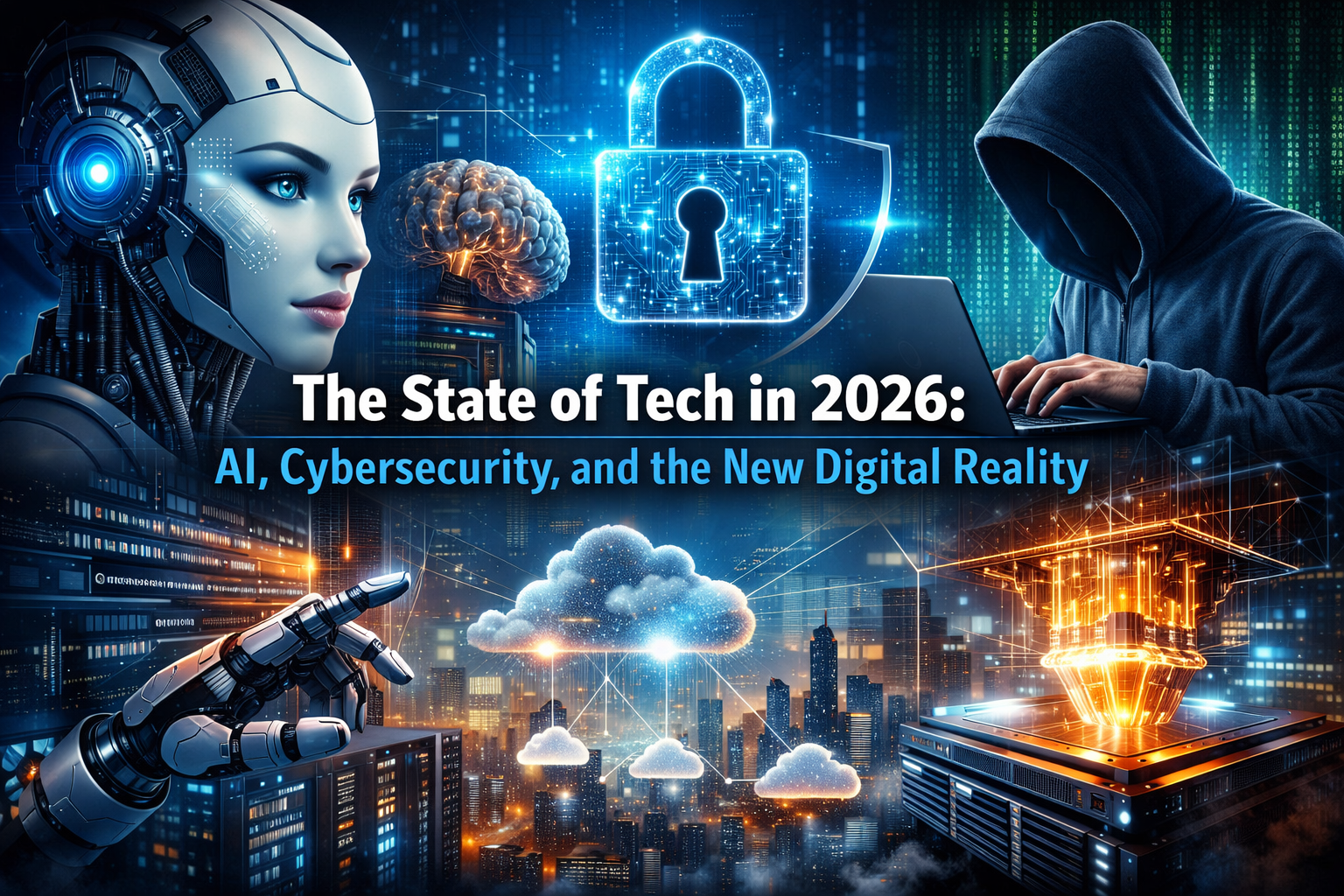
The State of Tech in 2026: AI, Cybersecurity, and the New Digital Reality

The technology landscape in 2026 isn’t just evolving—it’s accelerating at a pace that’s forcing businesses, developers, and everyday users to rethink how they interact with the digital world. What once felt like “emerging trends” are now foundational pillars: artificial intelligence, cybersecurity, and cloud infrastructure.

But this year marks a turning point. It’s no longer about experimenting with new tech—it’s about controlling it, securing it, and making it actually deliver value.

AI Has Moved From Hype to Responsibility

Over the past few years, AI has gone from flashy demos to real-world deployment. In 2026, companies are no longer asking “Can we use AI?”—they’re asking “How do we use it safely and profitably?”

Organizations are increasingly shifting toward specialized AI models trained on industry-specific data. These systems are more accurate, more efficient, and easier to govern. (Hardis Group)

At the same time, AI is becoming a double-edged sword:

  • It powers automation, analytics, and decision-making
  • But it also introduces new risks like data leaks and misuse

In fact, AI is now considered the single biggest driver of change in cybersecurity, reshaping both how attacks are carried out and how defenses respond. (World Economic Forum)

The takeaway? AI is no longer optional—but unmanaged AI is a liability.

Cybersecurity Is Now a Business Priority—Not Just IT

Cybersecurity has officially moved out of the server room and into the boardroom.

In 2026, cyber risk is tightly connected to business survival. A breach isn’t just a technical failure—it’s a financial, legal, and reputational crisis. (Forbes)

Several major shifts are defining this new era:

1. AI-Powered Attacks Are Getting Smarter

Hackers are using AI to automate attacks, generate convincing phishing messages, and exploit systems faster than ever.

2. Defense Is Becoming Automated Too

Security teams are deploying AI to detect threats in real time, respond instantly, and reduce human workload.

3. Quantum Computing Is Changing the Game

Post-quantum cryptography is no longer theoretical—organizations are actively preparing for a future where current encryption may become obsolete. (Forbes)

The result is a high-stakes arms race: AI vs. AI.

Cloud Computing Is Facing a Reality Check

Cloud used to promise unlimited scalability and predictable costs. In 2026, that illusion is fading.

With the explosion of AI workloads, cloud infrastructure is under pressure:

  • Compute resources are harder to secure
  • Costs are becoming more volatile
  • Performance bottlenecks are more common

This is pushing companies toward hybrid cloud strategies, combining public and private systems for better control and resilience. (TechRadar)

At the same time, data centers are becoming the backbone of the global economy—powering everything from banking to healthcare to AI itself. (The Australian)

In short: the cloud isn’t disappearing—it’s maturing.

The Privacy vs. Convenience Dilemma

As technology becomes more embedded in daily life, a critical tension is emerging: privacy vs. convenience.

AI systems rely on massive amounts of personal data to function effectively. But that same data raises serious concerns about surveillance, misuse, and lack of regulation. (New York Post)

Consumers are increasingly aware of the trade-off:

  • More personalization and smarter tools
  • In exchange for less control over their data

And right now, regulation is struggling to keep up.

What This Means for the Future

If there’s one theme that defines 2026, it’s this: technology is growing up.

We’re entering an era where success isn’t about adopting the newest tools—it’s about:

  • Building secure, resilient systems
  • Using AI responsibly and transparently
  • Designing infrastructure that can adapt to uncertainty

The companies that win won’t be the ones with the most advanced tech—they’ll be the ones that can manage complexity without losing control.

Final Thoughts

2026 isn’t the year of breakthrough innovation—it’s the year of accountability.

AI, cybersecurity, and cloud computing are no longer separate conversations. They’re deeply interconnected, shaping a digital ecosystem that demands smarter decisions and stronger safeguards.

The question isn’t what technology can do anymore.

It’s whether we’re ready to handle what it brings.

In this blog i write these articles more than once a week. Subscribe so you don’t miss out on other articles.

Top 10 AI Alternatives to ChatGPT (Best AI Chatbots in 2026)

AI tools are moving fast. ChatGPT still leads the pack, but you’ve got plenty of strong alternatives if you’re looking for something different. Some offer real-time web searches, others excel at deep reasoning or connect seamlessly with your favorite productivity apps. And a few specialize in pumping out killer blog posts or marketing content.

Honestly, no matter if you’re a blogger, a coder, a researcher, or you run a business, checking out these other AI chatbots can help you pick the right tool for your workflow.

Here’s a rundown of the top 10 alternatives to ChatGPT in 2026, plus their standout features and where to find them:

1.Google Gemini


Google Gemini goes head-to-head with ChatGPT and plugs right into Gmail, Docs, Drive, and the rest of Google Workspace. Handy for quick research or saving time on everyday tasks.

    Features:

    • Keeps you updated with real-time web info
    • Deep Google Workspace integration
    • Works with text, images, and code
    • Accepts voice and image inputs

    Website: https://gemini.google.com/

    2.Claude AI


    Anthropic built Claude, and it shines when you need solid reasoning or to chew through long documents. Researchers and writers love it for digging into detailed projects.

      Features:

      • Handles long-form writing like a champ
      • Eats big documents for breakfast
      • Thoughtful, nuanced reasoning
      • Built around safety-first AI principles

      Website: https://claude.ai/

      3.Microsoft Copilot


      Copilot lives inside Word, Excel, Teams, and Outlook, so if you’re already working in Microsoft land, productivity just gets easier. Great for business and work tasks.

        Features:

        • Deep Microsoft 365 integration
        • Smart writing and editing help
        • Analyzes data in Excel
        • Summarizes documents quickly

        Website: https://copilot.microsoft.com/

        4.Perplexity AI


        Think of Perplexity as part search engine, part chatbot. It finds answers fast and backs them up with sources, making it perfect for research and fact-hunting.

          Features:

          • Real-time searches across the web
          • Cites its sources for credibility
          • Research-focused answers
          • Simple, clean user interface

          Website: https://www.perplexity.ai/

          5.Jasper AI


          If you’re marketing or creating content, Jasper is built for you. It churns out blogs, ads, emails, captions—and lets teams collaborate on brand voice.

            Features:

            • Loads of marketing templates
            • Tools for teams
            • AI-powered blog writing
            • Customizable brand voice

            Website: https://www.jasper.ai/

            6.Chatsonic


            Chatsonic’s got internet browsing and its own image generator. Marketers and creators use it for real-time content and visuals.

              Features:

              • Accesses the web for up-to-date info
              • Generates images on the fly
              • Works with voice commands
              • Makes social content quickly

              Website: https://writesonic.com/chat

              7.Youchat


              YouChat is built into You.com’s search engine. It’s great for students and researchers, giving conversational answers right next to search results.

                Features:

                • Integrated AI search engine
                • Offers summaries for quick reference
                • Helps with academic research
                • Gives instant web answers

                Website: https://you.com/youchat

                8.Poe AI


                Poe lets you hop between AI models in one handy spot and even build custom chatbots. If you need flexibility, Poe’s got it.

                  Features:

                  • Multiple chatbot models in a single platform
                  • Custom chatbot creation tools
                  • Easy model switching
                  • Bots from the community

                  Website: https://poe.com/

                  9.DeepSeek


                  DeepSeek is making waves with developers and researchers, thanks to its strong reasoning and coding help (plus, it keeps costs low).

                    Features:

                    • Smart reasoning for tough tasks
                    • Assists with coding
                    • Affordable AI access
                    • Built for developers

                    Website: https://www.deepseek.com/

                    10.Meta AI (Llama)


                    Meta AI, powered by Llama, runs across Facebook, Instagram, WhatsApp—and developers can use its models to build their own apps. Multilingual and packed with strong reasoning.

                      Features:

                      • Open AI models for devs to build with
                      • Deep Meta app integration
                      • Supports multiple languages
                      • Great for reasoning and conversation

                      Website: https://ai.meta.com/

                      Pick the right one and you’ll save time, boost productivity, or just make your research and content sharper. There’s a chatbot out there for nearly every job now.